Money & Calculations
Black Friday 2026: How Stacked Discounts Really Add Up
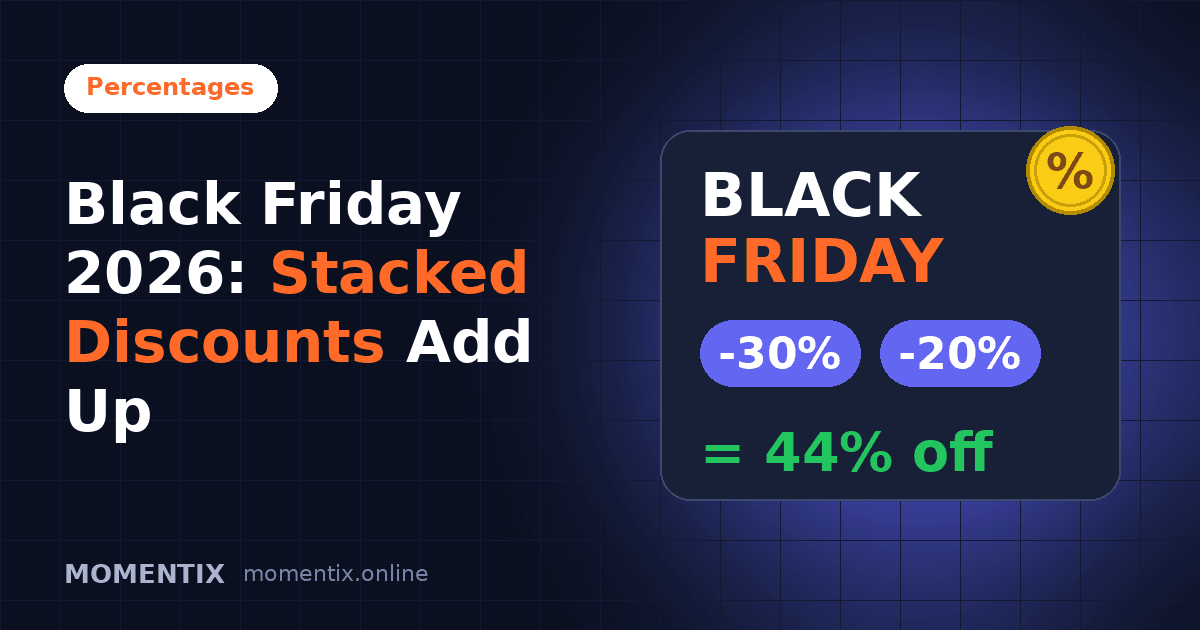
Black Friday is Friday 27 November 2026. Two discounts of 30% and 20% do not make 50% off: on £200 you pay £112, a 44% saving. Worked examples and a table.

Written by Ahad NoorPublished 6 min read
Black Friday 2026 falls on Friday 27 November 2026, the day after the fourth Thursday of November. Shops often show more than one offer at once: a sale price, then an extra percentage at the till, then a voucher. The headline numbers look as if they add up, but they do not.
When two percentage discounts are applied one after the other, the second is taken from the already reduced price. So 30% off followed by 20% off is not 50% off. On a £200 item you pay £112.00, a saving of 44.0%. This guide shows the rule, a table of common stacks, and what changes when a fixed-value coupon is involved. Every figure comes from the same function that the discount calculator uses. It is a supporting guide to percentages explained.
Contents
How do stacked discounts work?#
Each discount applies to the price that is left, not to the original price. To stack percentages, multiply the price by one minus each rate in turn.
Price after stacked percentage discounts
Final price = original × (1 − d1) × (1 − d2) × (1 − d3)
Real saving % = (original − final) ÷ original × 100
Write each percentage as a decimal: 30% = 0.30.
Worked example: 30% off then 20% off a £200 item
Assumptions: The two discounts apply one after the other to a £200 price, with no coupon.
- First discount: £200 × 0.30 = £60.00, leaving £140.00.
- Second discount: £140 × 0.20 = £28.00, leaving £112.00.
- Total saved: £200 − £112.00 = £88.00, which is 44.0% of the original price.
You pay £112.00. Adding 30% + 20% would suggest £100.00, which is £12.00 less than you actually pay.
You can check this yourself: open the discount calculator with £200, 30% and 20% filled in.
Common stacked discounts on a £200 item#
The table compares what you pay when discounts stack with what the added-up headline would suggest. The last column shows the price if the percentages were simply added, which is not how shops calculate them.
| Discounts | Percentages added up | You pay | Real saving | Price if simply added |
|---|---|---|---|---|
| 10% + 10% | 20% | £162.00 | 19.0% | £160.00 |
| 20% + 10% | 30% | £144.00 | 28.0% | £140.00 |
| 30% + 20% | 50% | £112.00 | 44.0% | £100.00 |
| 40% + 10% | 50% | £108.00 | 46.0% | £100.00 |
| 50% + 20% | 70% | £80.00 | 60.0% | £60.00 |
| 30% + 20% + 10% | 60% | £100.80 | 49.6% | £80.00 |
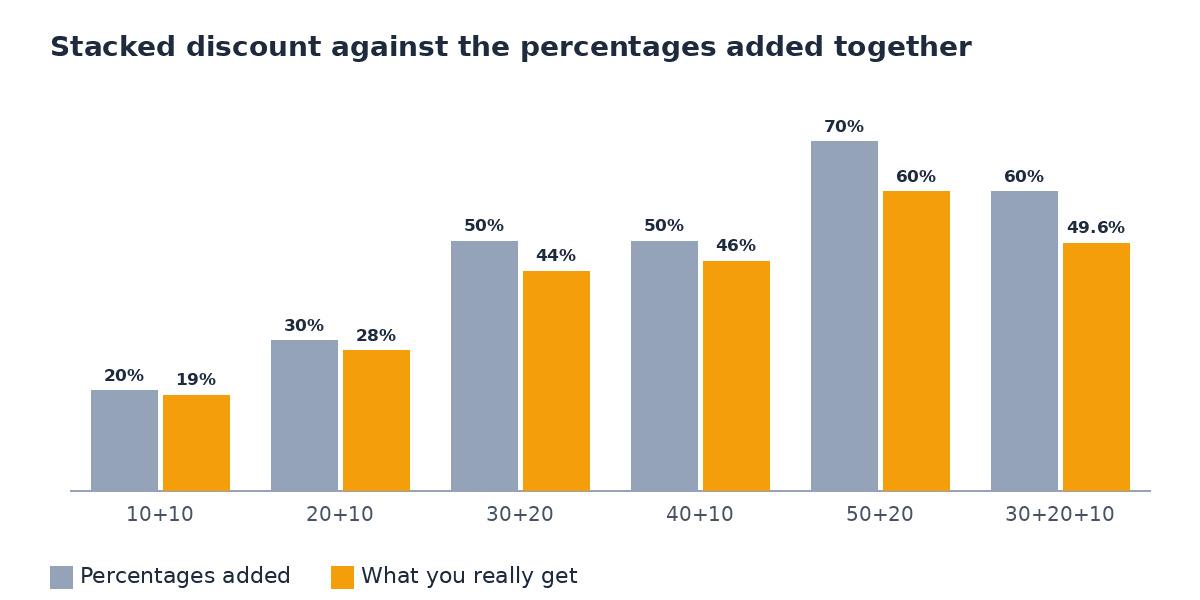
Three discounts follow the same rule: 30% + 20% + 10% on £200 leaves £100.80, a saving of 49.6% rather than 60%. The more discounts you stack, the bigger the gap between the headline and the real saving.
Does the order of a coupon and a percentage matter?#
For percentages only, the order does not matter: 30% then 20% costs the same as 20% then 30%, because multiplication gives the same result in either order. A fixed-value coupon is different. A £20 coupon taken off before a percentage is itself reduced by that percentage, so it is worth less.
| Order | You pay | Real saving |
|---|---|---|
| 25% off, then £20 coupon | £130.00 | 35.0% |
| £20 coupon, then 25% off | £135.00 | 32.5% |
Taking the percentage first and the coupon after gives £130.00; taking the coupon first gives £135.00. The difference is £5.00. Shops set the order in their terms, so read how the voucher is applied at the checkout before you rely on a total.
When is Black Friday 2026?#
Black Friday is the Friday after the fourth Thursday of November. In 2026 the fourth Thursday is 26 November, so Black Friday is Friday 27 November 2026. Cyber Monday is the Monday after it, 30 November 2026. Many shops start their offers before these dates, so the date is when the name applies, not when every price is lowered.
Common mistakes with stacked discounts#
Before you trust a stacked price
- Work out the price after each discount in order, not one added-up percentage.
- Find out whether a coupon is taken before or after the percentage.
- Check the shop's terms: some codes cannot be combined with sale prices.
- Compare the final price, not the percentage, between shops.
Mistake: Adding the percentages: 30% + 20% = 50% off.
Instead: The second discount applies to the reduced price, so the real saving is 44.0%.
Mistake: Assuming a £20 coupon is worth the same before or after a percentage.
Instead: On £200 with 25% off, it is worth £20 after the percentage but only £15 before it: £130.00 versus £135.00.
Mistake: Trying to reverse two discounts by adding the percentages back.
Instead: Divide the final price by each factor. A price of £144 after 40% and 10% off was 144 ÷ 0.54 = £266.67.
Try the tool
Discount Calculator
Apply one, two or three percentage discounts and an optional coupon in order, and see each step, the final price and the real saving.
Open the Discount CalculatorMore guides and calculators on this topic#
This guide is a supporting article for Percentages and maths. The overview is Percentages Explained: Of, Increase, Decrease and Reverse.
Frequently asked questions#
Friday 27 November 2026. It is the day after the fourth Thursday of November, which is 26 November in 2026. Cyber Monday is Monday 30 November 2026.
No. The 20% is taken from the price after the 30%, so a £200 item costs £112.00, a 44.0% saving.
Multiply the price by one minus each discount as a decimal. For 30% and 20%, that is price × 0.70 × 0.80, which is price × 0.56.
No. Multiplication gives the same result in either order, so 30% then 20% costs the same as 20% then 30%.
Yes. On £200 with 25% off and a £20 coupon, the percentage first gives £130.00 and the coupon first gives £135.00.
Divide the price you paid by each factor. A price of £144 after 40% off and then 10% off was 144 ÷ (0.60 × 0.90) = £266.67.
Ahad Noor
Ahad Noor builds and maintains Momentix, including its calculators, converters and the guides on this blog.
Each guide is checked against the matching Momentix tool, so the worked examples show the same figures the tool gives for the same inputs.